


META CAN KILL YOUR BUSINESS BEFORE BREAKFAST

At 7:55 this morning, I had a Facebook account, nearly two decades of family memories and access to several businesses I manage across Meta’s platforms. By the time my 8:00 a.m. meeting began, an automated decision had put all of it at risk—with no human being, meaningful explanation or genuine appeal in sight.
Category: From the Editor’s Desk
7:55 A.M. IN GUADALAJARA
I am writing this from Guadalajara, Mexico, at the end of a day that began much earlier than I wanted it to. I went to sleep around 3:00 this morning and was awake again by 6:00 for an 8:00 a.m. call. It was not the kind of night that leaves much room for patience, reflection or the sudden collapse of your digital identity.
By 7:55, I was ready for the meeting. My computer was open, Zoom was waiting and I had five minutes to spare. Like billions of people around the world, I used those five minutes to check Facebook without thinking that anything meaningful could have changed while I slept.
I was not expecting news. I was not anticipating a crisis. I was doing something so habitual that it barely registered as a decision.
Then the screen changed.
“Hi Joseph,
Your Facebook account has been suspended.”
The accompanying email was more direct: “Joseph, you have 180 days to take action.” It said that my account or activity on it did not follow Facebook’s Community Standards on account integrity. If I believed the suspension was a mistake, I could appeal.
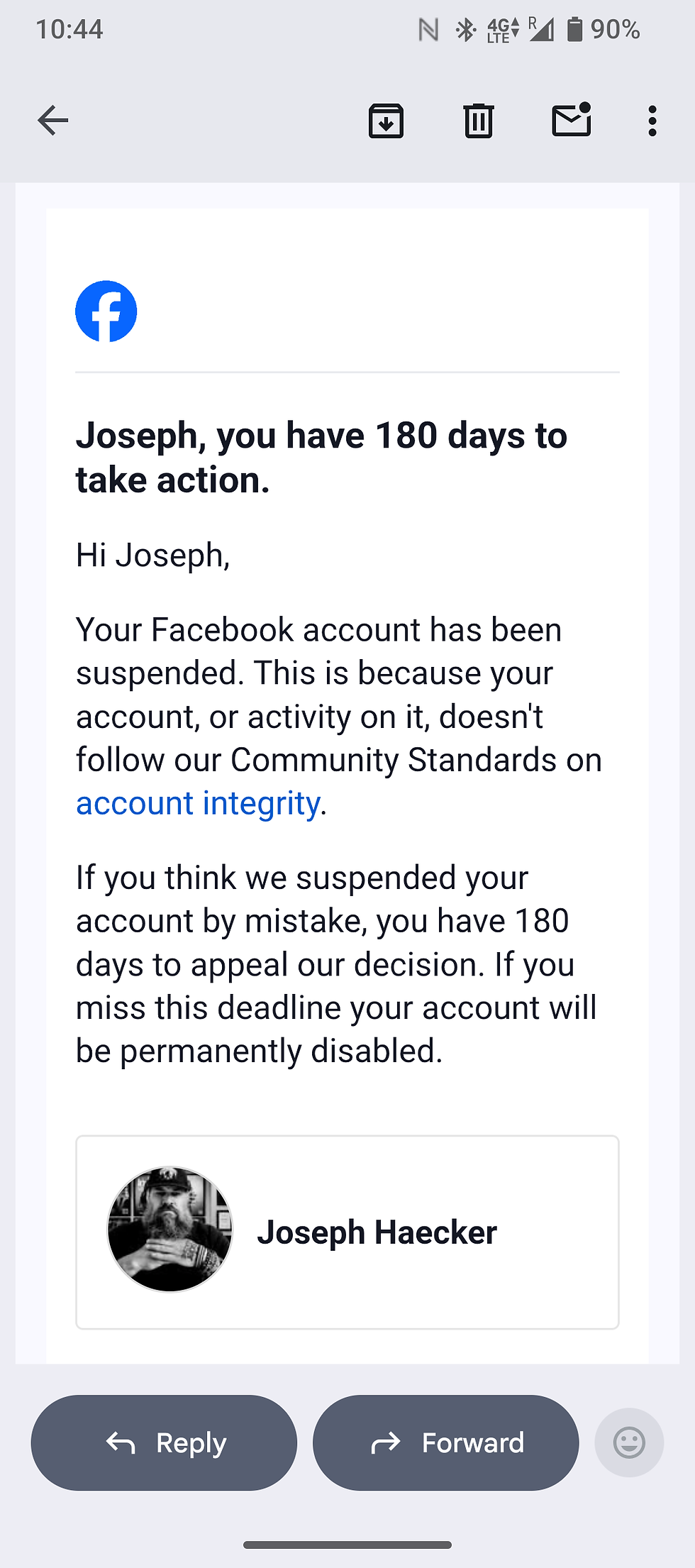
There was no example of the activity in question. No suspicious post was shown. No message was identified, no piece of content was flagged and no action was explained in a way that would allow me to understand what I had supposedly done.
The language was institutional and absolute, yet strangely empty. Facebook had reached a conclusion significant enough to suspend my identity but had not provided enough information for me to respond intelligently. I was being invited to appeal a charge that had never actually been described.
This was not a new account created for a temporary campaign. I have been on Facebook for most of my children’s lives. They are now 27 and 28 years old.
Think about what that means.
My Facebook account spans years in which my children grew from kids into adults. It contains photographs, conversations, connections, birthdays, projects, announcements, friendships, introductions and pieces of a life that have accumulated across nearly two decades. Some of the people connected to that history remain part of my daily life, while others now exist primarily inside those archives.
There are moments stored there that I would not necessarily know how to find anywhere else. There are old messages whose significance became greater with time, photographs taken on devices I no longer own and relationships that were maintained because Facebook made it easy to remain loosely connected across years and distance. Whether Meta acknowledges it or not, people have entrusted parts of their personal histories to the platform.
But my account did not contain only memories.
I run several businesses with presences across Facebook and Instagram. Those accounts represent publications, platforms, communities, content, professional relationships and years of work. They are places where people discover what we are building, read the stories we publish, communicate with us and decide whether they want to participate.
My personal identity sits behind parts of that infrastructure. It helps administer pages, access business assets, manage communication and maintain continuity across the companies I operate. When Meta suspended me, it did not remove one isolated profile from a recreational website.
It threatened the administrative doorway into an ecosystem.
That distinction is difficult to understand until it happens to you. A founder may have several public pages, brand accounts and business tools, but Meta frequently requires those assets to remain connected to an individual identity. The personal account functions as the key ring even when the businesses are separate entities with different audiences and purposes.
If Meta takes the person, it may also take the keys.
There I was in Guadalajara, five minutes before an important business call, attempting to understand whether I had lost one account or the digital infrastructure connected to several companies. There was no support representative to contact and no visible case manager assigned to the decision. There was simply an appeal button and a clock moving toward 8:00.
THREE MINUTES BEFORE THE MEETING
With three minutes remaining, I pressed the button to appeal.
There was no space for a thoughtful explanation. I could not describe the businesses connected to the account, ask what activity had triggered the suspension or provide context for anything Meta’s systems may have misunderstood. The process did not feel like presenting a case; it felt like confirming that I objected before the machinery continued.
I submitted the appeal.
The response was nearly immediate.
“Your review was unsuccessful.”
The message continued:
“Hi Joseph,
Your Facebook account has been permanently disabled.
You requested a review of this decision, but we still found that your account, or activity on it, didn’t follow our Community Standards. You can’t request another review.”

Read that sequence again.
At 7:55, Facebook told me that I had 180 days to appeal. Within minutes, I submitted the appeal, the review was completed, the decision became permanent and I was informed that I had no remaining options. A process supposedly available for six months was exhausted before my meeting began.
I do not know whether a human being examined the account. Meta did not tell me. If someone did, the speed of the response and absence of any specific explanation made the review indistinguishable from an automated rejection.
That matters.
A company can describe a process as an appeal, but the existence of a button does not create due process. An appeal should offer a person some meaningful opportunity to understand the accusation, present relevant information and receive a reasoned decision. Otherwise, it is theater performed by software.
The entire judicial system appeared to fit inside three minutes. Meta made the accusation, accepted the appeal, completed the review and issued a permanent judgment. The same institution served as investigator, prosecutor, judge and final court of appeal.
No evidence was presented.
No conversation took place.
No person became visible.
No further review was available.
The word permanently did most of the emotional work. It told me that nearly two decades of history and access could disappear without a specific explanation. It also told me that Meta considered the matter closed even though I still did not know what the matter was.
There is something psychologically destabilizing about being punished without being told what you did. You begin searching your own recent behavior for possibilities. You replay posts, logins, messages, business activity and any unusual action that might have been interpreted incorrectly.
Was the account compromised? Did an unfamiliar login trigger something? Was a legitimate business page incorrectly connected to prohibited behavior? Did a word, image, link or administrative action get stripped of context by a moderation system?
Meta did not say.
This is where opaque enforcement becomes more than a customer-service failure. The user is forced to imagine the accusation because the platform will not clearly state it. You are expected to defend yourself from a conclusion while guessing which facts might be relevant to your defense.
Meanwhile, the ordinary day does not stop.
I still had a meeting at 8:00. The person on the other side of that Zoom call had their own schedule, priorities and expectations. The businesses attached to my accounts still required decisions, communication and work.
Founders do not receive emergency leave because a platform suddenly deletes their access.
I had one minute left.
I opened Instagram.
RESTORED AT 8:08. SUSPENDED AGAIN BY 5:55.
Instagram greeted me with another warning:
“Take action or lose access to onlyfansinsidermagazine.”
The account for Only Fans Insider Magazine had been suspended too. According to Instagram, the issue involved Meta’s Community Standards on human exploitation.
The accusation was particularly jarring because Only Fans Insider Magazine is a publication built to feature creators, businesses and people working throughout the creator economy. It is an independent, PG-13 digital magazine. It publishes interviews, business stories, lifestyle coverage and editorial content.
Since launching the magazine on May 14, 2025, we have worked to create something the industry has rarely been given: a credible publication in which creators can tell their stories in their own words. The magazine has reached more than 40.3 million readers. It has featured creators, agencies, founders and companies whose experiences are too often flattened into stereotypes by people who have never spoken with them.
The accusation of human exploitation did not come with a specific article, post or image. Instagram did not tell me whether the concern involved a piece of content, a caption, a link, a person we had featured or something else entirely. The account was simply placed behind another appeal screen.
My meeting was starting.
I filed the appeal.
Then I joined Zoom.
Imagine trying to change mental gears in that moment. Seconds earlier, I was being told that years of personal history and access to several businesses could be permanently gone. Now I needed to enter a professional conversation, be present, listen carefully and behave as though my morning had not just been detonated by two notifications.
This is part of the hidden cost of platform enforcement. We talk about suspended accounts as technical events, but technical events happen to human beings in the middle of human lives. They arrive before meetings, during launches, after bad nights of sleep and on days when there is already more work than time.
At 8:08 a.m., while my call was underway, Instagram sent another message:
“You can use onlyfansinsidermagazine again.”
The email continued:
“Thanks for taking the time to request a review. We reviewed your account and found that the activity on it does follow our Community Standards on human exploitation, so you can use Instagram again.”
That should have been reassuring.
In one sense, it was. Instagram had acknowledged that the publication’s activity followed its standards. The system had made a mistake, and the appeal appeared to have corrected it.
But the reversal also exposed the fragility of the original decision. Minutes earlier, the account had been treated as sufficiently problematic to suspend. Now Meta was confirming that the activity complied with the very standard it had supposedly violated.
Nothing about the publication had changed during those minutes.
We had not rewritten an article, removed a post or altered the purpose of the account. The only thing that changed was Meta’s conclusion. The account moved from unacceptable to compliant without any underlying conduct being modified.
That should make every business owner uncomfortable.
We often assume that platform rules operate like clearly marked lines. Stay on the correct side and your business will remain safe. But when identical activity can be classified as prohibited at 7:58 and compliant at 8:08, the line is not fixed in a place the user can reliably see.
The line moves inside the system.
For the next several hours, it appeared that the Instagram problem had been resolved. I continued with the day, worked through the meetings and attempted to understand what, if anything, could be done about Facebook. There was still no meaningful path back into the personal account.
Then, at 5:55 p.m., the Instagram screen changed again.
“You submitted an appeal on October 15, 2026.”
The message said:
“It usually takes us just over a day to review your information. Check back here.
Your account is not visible to people on Instagram, and you can’t use it.”
The same account Meta had restored at 8:08 that morning was suspended again before dinner.
No new violation was identified.
No additional explanation appeared.
No person contacted me.
I went from suspension, to successful appeal, to reinstatement, to another suspension in less than one business day. Meta had first concluded that Only Fans Insider Magazine violated its standards, then concluded that it followed those standards, then removed it from public view again.
This is not a philosophical debate about whether social networks need rules. It is a documented contradiction happening to the same account on the same day. The platform could not maintain a consistent conclusion about whether our activity complied with its policies, yet each conclusion carried immediate consequences for our ability to operate.
At that point, there was no action available that felt rational. Should I appeal again and trust the same process that had already contradicted itself? Should I wait and hope a different system produced a different answer? Should I assume the account would return, or begin planning as though it were gone?
A business cannot make sound decisions when the infrastructure beneath it behaves unpredictably.
That uncertainty is itself a form of damage.
Even if the account is eventually restored, the interruption has already occurred. The publication becomes invisible, links stop working as expected, planned promotions are interrupted and readers may assume the brand disappeared. Every person who would have discovered us during that window is lost without ever knowing there was something to find.
Platforms tend to measure enforcement in accounts reviewed, posts removed and appeals processed. Businesses experience it in missed opportunities, damaged confidence and hours redirected from productive work into navigating systems that refuse to explain themselves. Those costs rarely appear in a transparency report.
I DIDN’T LOSE ONE ACCOUNT. I LOST ACCESS TO AN ECOSYSTEM.
The first instinct is to describe this as losing a Facebook account.
That description is too small.
I did not merely lose access to one profile. I lost access to an identity that sat at the center of multiple personal, professional and commercial relationships. I lost the doorway through which I entered an interconnected system of pages, publishing tools and business assets.
Meta has spent years encouraging this integration.
It wants the personal account connected to the business page. It wants Instagram connected to Facebook, advertising connected to Business Manager and audience communication flowing across Messenger, WhatsApp, Threads and the rest of its products. The convenience of the ecosystem is part of the value proposition.
One login allows you to move between multiple responsibilities. One advertising system can place content across different platforms. One company can supply identity, publishing, audience, messaging, analytics and customer acquisition.
Until the one login disappears.
Then the convenience reveals its second face: concentration risk.
When several business functions depend on one company, a single enforcement decision can travel farther than it should. The suspension of a personal account can interfere with a page. The suspension of a page can interrupt advertising, and the suspension of an Instagram account can eliminate access to an audience built over years.
This is how a platform can kill a business overnight.
It does not need to seize your bank account, cancel your corporate registration or remove your website. It only needs to disconnect you from the place where your customers have been trained to find you. For some businesses, that loss of visibility is enough to stop the flow of new revenue almost immediately.
Consider a local service provider that receives most of its inquiries through Instagram messages. Consider a creator whose subscriptions depend on traffic generated from social posts, or a retailer whose product launches are organized around Facebook and Instagram advertising. Consider a new company that has never developed an email list because every customer relationship began inside a platform inbox.
Now remove the account without warning.
The business may still legally exist, but its practical access to the market can disappear. Employees still need to be paid, vendors still expect invoices to be honored and customers still need support. The algorithm does not assume responsibility for any of those obligations.
This is why “just use another platform” is not a serious answer.
Audiences are not interchangeable piles of usernames. Each platform contains different relationships, behaviors, histories and forms of trust. A person who has followed your company on Instagram for five years does not automatically appear when you open an account somewhere else.
Network effects are not portable.
Meta does not legally own every possible route to an audience, but it controls several of the most important routes at once. Facebook, Instagram, WhatsApp, Messenger and Threads collectively occupy an enormous share of the world’s social and communications infrastructure. Meta reported approximately 3.6 billion daily users across its family of applications during the second quarter of 2026, while Instagram alone reached two billion daily users.
That scale changes the meaning of choice.
A restaurant can decide not to use Instagram, but its customers may still use Instagram to decide where to eat. A consultant can refuse Facebook, but the professional communities and event groups relevant to their work may remain there. A creator can build elsewhere, but brands evaluating that creator may still use Instagram as a shorthand for legitimacy.
You can leave Meta.
You cannot force the rest of the market to leave with you.
That is why Meta does not need to satisfy the strict legal definition of a monopoly to exercise monopoly-like power over particular businesses. Its dominance comes from controlling overlapping networks that founders, advertisers and consumers have incorporated into everyday behavior. The question is not whether alternatives technically exist; the question is whether losing access to Meta creates a commercially realistic substitute.
For many small businesses, it does not.
The relationship is especially unequal because the business creates much of the value Meta monetizes. Companies produce content, attract audiences, pay for advertising, respond to customers and help keep people inside the ecosystem. Meta then sells access to those audiences back to the same businesses.
The business builds the page.
The business earns the followers.
The business pays to reach them.
Meta retains the power to make the page disappear.
We use ownership language when describing this arrangement because the interfaces encourage it. We say my account, my page, my followers and my audience. Those possessive words create a comforting illusion of control.
But the account exists under a license.
The page exists under conditions Meta can interpret.
The followers remain inside Meta’s database.
The audience relationship is mediated by software you do not own.
That does not mean social platforms have no value. They are extraordinarily powerful tools for discovery, communication and growth. The problem begins when a useful channel becomes the foundation beneath the entire business.
There is a difference between using rented infrastructure and building as though the lease can never be terminated.
Most entrepreneurs know better than to give a single customer 100% of their revenue. They understand the danger of relying on one supplier, one employee or one source of financing. Yet many will confidently place nearly all of their market access inside one family of social platforms.
The dependency feels safe because Meta is enormous. We assume that a company serving billions of people must have sophisticated processes capable of recognizing legitimate businesses and correcting obvious mistakes. Scale, however, can produce efficiency without producing care.
Meta may know everything about account behavior at the level of data. It can analyze logins, content, connections, devices, clicks, advertising and patterns across billions of interactions. Yet in the moment when a real person needs someone to understand the context behind that data, the company can feel almost unreachable.
That is the paradox.
Meta is intimately familiar with your behavior and institutionally unavailable to you as a human being.

FUCK META
There is a polished version of this article in which I avoid saying what I actually felt.
In that version, I would write that I am “disappointed by the user experience.” I would express “concern regarding the appeals process” and recommend that Meta “consider greater transparency.” Every sentence would be professionally acceptable and emotionally dishonest.
So let me say it plainly.
Fuck Meta.
I do not say that because platforms should abandon moderation. Facebook and Instagram operate at a scale that exposes them to fraud, impersonation, exploitation, harassment, illegal content, organized manipulation and abuse. Any responsible platform has to create rules and enforce them.
I know that as the founder of Sxgram.com
Building a social platform makes it impossible to pretend that every moderation decision is simple. Rules must protect users, legal obligations must be honored and genuine abuse cannot be ignored in the name of unrestricted expression. A platform without enforcement does not remain free; it becomes controlled by whoever is most willing to harm others.
But enforcement without accountability creates a different kind of danger.
When a company can remove someone’s identity, history and commercial access, it owes that person more than a vague policy category. It should identify the activity at issue, explain the relevant rule and offer a meaningful opportunity to correct a mistake or challenge the conclusion.
That is especially true when the alleged violation is as serious as human exploitation.
If Only Fans Insider Magazine had published content that actually facilitated exploitation, I would want to know immediately. I would want the specific material identified, the concern explained and the opportunity to investigate what happened. Responsible operators cannot correct what platforms refuse to describe.
Instead, the account was suspended, restored and suspended again.
Meta’s own decisions became the strongest evidence that the process was unreliable. The company declared that our activity violated its standards, then declared that it complied with the same standards. Hours later, it removed the account again without explaining what had changed.
Nothing about that sequence increases safety.
It does not help a legitimate business understand its responsibilities. It does not distinguish harmful activity from a false positive, and it does not build confidence that serious allegations are being reviewed with serious care. It simply transfers the cost of uncertainty onto the user.
The most troubling word in the Facebook message was not disabled.
It was review.
A review suggests reconsideration. It suggests that the original decision will be evaluated again, ideally with new attention, additional context or a different level of judgment. It implies that errors are possible and that a system exists to correct them.
What I experienced did not feel like reconsideration.
The response arrived so quickly that it appeared to confirm the first result rather than meaningfully examine it. There was no explanation of the evidence and no indication that the appeal had been considered differently from the original enforcement action. The button existed, but the user had no way to see whether anything behind it changed.
Meta may insist that some appeals receive human attention. Perhaps mine did. From the outside, there was no meaningful difference between a human review and an automated rejection, which is itself a failure of process design.
If a human made the decision, the reasoning remained hidden.
If a machine made it, accountability remained hidden.
Either way, the affected person was left speaking to a wall.
This matters even more as Meta increases its reliance on artificial intelligence for content and account moderation. The Financial Times reported in June that Meta had already replaced approximately half of some human-review operations with large language models and was considering using them for more than 90% of certain review categories. Meta believes these systems can detect violations more efficiently, while internal concerns reportedly include harmless material being removed or restricted incorrectly.
AI can identify patterns at a scale no human workforce could match. It can surface suspicious behavior, group related signals and process enormous volumes of content. Those capabilities make it valuable.
But pattern recognition is not the same thing as understanding a life or business.
A system may recognize a word associated with adult content without understanding the editorial context in which it appears. It may identify links, images or relationships correlated with prohibited activity while failing to understand that the account belongs to a legitimate publication reporting on an industry. It may see risk signals without seeing the person behind them.
This is not an argument that humans never make mistakes. They do.
A rushed contractor working from a queue can misunderstand context. Reviewers can apply policies inconsistently, and large moderation organizations can develop bureaucratic habits that produce bad decisions. Human involvement is not a magical guarantee of fairness.
The difference is that human judgment can be questioned, explained and held responsible when the system is designed to permit it.
AI should help platforms make decisions. It should not become a shield that allows institutions to make consequential decisions without anyone being answerable for them. Automation can increase speed, but speed becomes dangerous when the decision being accelerated is wrong.
My appeal was processed with extraordinary speed.
My understanding of the allegation did not improve at all.
That is the problem.
Meta knows how much businesses depend on its infrastructure because that dependency is central to its business model. Advertising accounted for more than 98% of Meta’s revenue in the first quarter of 2026. Companies pay Meta precisely because Facebook and Instagram sit between them and the customers they need to reach.
Meta monetizes the relationship from both sides.
Users bring their attention.
Businesses bring their content and money.
Meta controls the bridge.
When that bridge closes, the business is expected to accept the interruption as a policy event rather than an economic injury. Meta does not reimburse the company for missed leads, lost visibility or the time required to navigate an appeal. It does not calculate the lifetime value of the audience connection it severed.
To Meta, my case may be one account in a moderation queue.
To me, it touches multiple businesses, years of work and much of my children’s lives.
Both descriptions can be factually accurate, but only one captures the human stakes.
This is where scale can become an excuse. A platform may argue that it cannot provide individual attention to every person among billions of users. But Meta chose to build, acquire and integrate services at that scale.
Scale is the source of its revenue and market power.
It cannot be celebrated when selling advertising and treated as an unavoidable limitation when users need accountability.
The company wants businesses to trust its targeting, automation, analytics and AI when those systems help Meta generate revenue. It asks advertisers to believe that its technology can identify the right person, optimize the right campaign and predict the right commercial outcome. Yet when similarly powerful systems incorrectly classify a legitimate account, the affected business is told almost nothing.
Apparently, the machines understand us well enough to sell us something.
They simply do not understand us well enough to hear an appeal.
That deserves anger.
Not performative outrage manufactured for engagement, but the clear anger of someone who has followed the rules, built legitimate businesses and watched an unaccountable system threaten all of them before breakfast.

THIS IS WHY I LAUNCHED SXGRAM
This morning did not create my beliefs about platform dependency. It confirmed them in the most personal way possible. Five minutes before a meeting, I watched one company threaten years of family history, several businesses and my ability to communicate with the communities I had spent years building.
I could have treated this as an isolated customer-service failure. I could have waited for the next appeal, hoped a different automated system produced a better answer and returned to business as usual if the accounts came back. But that would ignore the larger problem the experience exposed.
For years, I have watched creators and businesses build enormous value on platforms they do not control. They create the photographs, videos, ideas and conversations that give people a reason to open those applications. They attract the audiences, generate the engagement and create the commercial activity, while the platform retains control of the relationship.
That imbalance becomes particularly dangerous for adult creators and the lawful businesses that serve them. They are expected to behave like entrepreneurs while operating inside systems that may refuse to recognize them as legitimate businesses. They can follow the law, follow the published rules and still wake up one morning to find that an invisible system has decided they no longer belong.
Build a brand—but understand that your account may disappear.
Develop an audience—but recognize that you may never be allowed to reach it again.
Create a legal business—but accept that the infrastructure almost every other entrepreneur uses may decide your category is too uncomfortable to support.
That is the environment in which Sxgram was born.
I did not launch Sxgram because the world needed one more place to post photographs, chase likes or scroll through another endless feed. I launched it because lawful adult creators, influencers and businesses deserve a platform built from the beginning with the understanding that they are real people operating real businesses.
The thesis behind Sxgram is simple:
"If you operate a legal business, you should be able to market and advertise your legal business."
That does not mean a platform without standards. Sxgram.com is an adults-only community, and it has serious responsibilities involving consent, legality, impersonation, exploitation, harassment and user safety. Supporting lawful adult expression does not mean tolerating abuse, and respecting creators does not mean abandoning responsible moderation.
The difference is that a platform should be capable of enforcing its rules without forgetting the human being affected by them. If an account represents someone’s livelihood, history or professional identity, that person deserves to know what happened. They deserve a meaningful explanation, a genuine opportunity to respond and an appeal that is more than a button connected to the same machinery that made the first decision.
Sxgram is not intended to become another closed world that traps creators inside it. We are building an ecosystem that connects social identity to broader opportunities: editorial coverage through SxM Magazine, podcast discovery through SxRADIO, professional visibility through SxLINKS, product discovery through Product Cards and commercial relationships through the Affiliate Program Marketplace.
The objective is not simply to give people another audience they can lose. It is to help them turn participation into relationships, stories, visibility and opportunities that can extend beyond any individual post. A social platform should help its members build something—not merely keep them producing content for the platform’s benefit.
Sxgram will make mistakes as it grows. Every platform does, especially when balancing expression, safety, legality and scale. The real test is not whether a company can pretend its systems are perfect; it is whether it remembers that its mistakes happen to people.
What happened to me today will remain part of how I think about that responsibility. It is easy to criticize Meta’s lack of human communication while Sxgram is still growing. The harder and more important commitment is to remember this experience later, when automation becomes tempting, moderation volume increases and individual cases become easier to view as numbers in a queue.
A platform should never be able to say, “The system decided,” and consider the conversation finished. Technology can identify risks, organize evidence and help people make decisions, but responsibility must remain with the company operating it. Algorithms do not answer for the livelihoods they interrupt.
I still believe businesses should use Facebook and Instagram. Their reach is real, their tools can be valuable and abandoning them entirely may hurt a company more than it hurts Meta. But no entrepreneur should mistake usefulness for ownership or convenience for security.
Build on those platforms, but build beyond them too.
Own your domain. Develop direct relationships. Preserve your content, build an email list and create more than one path through which people can find you. Never allow a platform-controlled follower count to become the only bridge between your business and the people it serves.
That lesson applies to Sxgram as well. I do not want members to exchange complete dependency on Meta for complete dependency on us. I want Sxgram to become part of a broader foundation that helps creators and businesses establish identities, relationships and opportunities they can carry with them.
At 7:55 this morning, Meta reminded me what happens when a platform forgets that an account belongs to a person. By 8:00, it had turned years of work, memories and business access into an unexplained policy decision. By 8:08, one of its own systems had already contradicted another.
So yes, I am angry.
But anger is not the reason I launched Sxgram. I launched it because anger without an alternative changes nothing. If I believe lawful creators and businesses deserve something different, then my responsibility is not merely to criticize the platforms that failed them—it is to help build the alternative.
That is what Sxgram represents to me.
It is a belief that legal businesses deserve the right to participate in the digital economy. It is a commitment to treating adult creators as professionals, entrepreneurs and human beings. And it is a reminder that behind every account, profile, publication and business page is a person whose life cannot be responsibly reduced to an automated decision.
Meta showed me today how easily a platform can make someone disappear.
I launched Sxgram.com because they should have somewhere else to be seen.




Comments