


What Hollywood Figured Out That Spicy Creators Haven't
- Lila Monroe

- Jun 24
- 28 min read
By Lila Monroe | Staff Writer, Only Fans Insider Magazine
I've been thinking about this for a while now — and honestly, I can't stop.
Every week, I watch incredibly smart, hard-working creators grind out content on platforms that actively suppress them, shadowban them, delete them, or simply demonetize them without warning. They post teasers to Instagram. They get flagged. They post to TikTok. They get removed. They post on Reddit. They play by the rules — post here, soft-sell there, never say the name of the platform you're actually building your business on — and they treat this cycle like it's just the cost of doing business in the creator economy. Most of the advice available to them points in the same direction: optimize your funnel, automate your DMs, post three times a day, and for the love of everything, never say "OnlyFans" out loud on a platform that might punish you for it.
I understand why people are excited about those tactics. Some of them work, at least some of the time, for some percentage of creators. But I also think we're missing something. Something obvious. Something hiding in plain sight, dressed in a tuxedo, walking a red carpet, giving interviews to Vanity Fair and showing up on the cover of Rolling Stone.
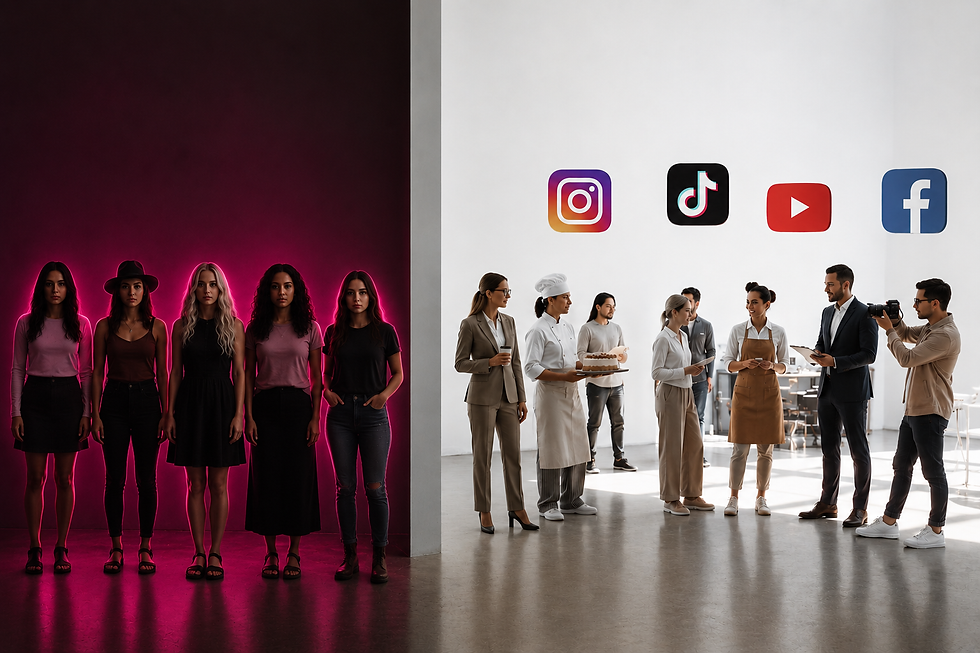
Hollywood has been doing this for decades. And creators — even the most entrepreneurially minded, most marketing-savvy, most business-oriented creators I've met — haven't stolen the playbook. Not even close. What most of them have done instead is try to run a Hollywood studio's distribution strategy using a lemonade stand's infrastructure, on someone else's street corner, under someone else's rules, waiting for permission that is never going to come.
That made me stop for a second when I really thought through it. Because the content isn't the problem. I've talked to enough creators to know that the content is often genuinely good — thoughtful, creative, brave, sometimes funny, sometimes deeply intimate in ways that mainstream media wouldn't dare. The problem isn't the content. The problem is everything that happens before the content is released, and almost nothing that should happen after it.
So let's talk about what Hollywood actually does. Not the mythology of it. The actual mechanics.

Before a single ticket is sold, a studio identifies a concept and assembles a cast around it. They begin production — and well before the film is done, information starts to leak. Some of it is organic. Most of it is not. A candid photo from set. A rumor about tension between cast members. A first-look image dropped to one outlet on a Tuesday morning when no other news is breaking. A cryptic tweet from one of the leads that says just enough to make people speculate. A casting announcement timed to a slow news cycle. All of this is deliberate. It is the product of publicists, marketing teams, studio executives, and talent managers working in carefully coordinated concert, and it begins months — sometimes years — before the film hits screens.
Then comes the press tour. The cast goes on the talk shows. They do the podcast circuit. They sit with the magazines. They play games on YouTube channels that generate millions of views. They let the internet find the moments — a look between two actors, an off-script answer, an emotionally raw interview — and turn those moments into shared cultural experiences. The trailer drops at exactly the moment audience interest peaks, because they've been tracking the metrics. The film hits theaters and the box office numbers are declared record-breaking. The hype machine wasn't just promoting a product. It was the product.
Now compare that to what most spicy content creators do. They finish a shoot. They post it. They write a caption. They hope the algorithm — on a platform that is actively trying to prevent people from seeing it — picks it up. They move on to the next shoot. They post again. The audience never had time to anticipate anything, because anticipation requires a gap between the announcement of something and the delivery of it, and most creators are eliminating that gap entirely in the name of consistency.
I don't think we're asking the right question when we talk about creator marketing. We keep asking "how do I reach more people?" when the better question is "how do I make the people who already know about me care more deeply, stay longer, and feel something when I release something new?" Hollywood answered that question fifty years ago. Three times, actually. Three distinct models, each with its own architecture, each with its own mechanics, and each with lessons that translate directly into what creators could be doing right now.
Joseph (Editor-in-Chief of Only Fans Insider Magazine) and I have talked about this more than once. He tends to frame it as a systems problem — he's always thinking in systems, which is useful, but also means he sometimes misses the human texture of what's actually happening on the ground. From where I sit in Brooklyn, talking to actual creators who are posting into the void every single day, it reads less like a systems failure and more like a fundamental language barrier. Creators are fluent in posts. Hollywood is fluent in events. And those are not the same thing at all.
So let's talk about the three models. Not the theory of them. The actual mechanics — and what creators could do with each one, right now, today, with the tools and audiences they already have.
The Platform Problem Nobody Wants to Say Out Loud
Before I get into the models, I need to say something that I keep tiptoeing around in this column and I'm tired of tiptoeing.
The social media platforms that most creators are using to build their audiences are not their friends. They are not neutral distribution infrastructure. They are businesses with their own rules about what content is acceptable, and those rules are applied inconsistently, opaquely, and often in ways that disproportionately punish creators whose content exists anywhere near the adult space — even when that content is completely legal, completely consensual, and completely above board by any reasonable standard.
I've watched creators spend years building Instagram followings, only to have them wiped out overnight by an algorithm update or a moderation decision they were never given a real reason for. I've watched TikTok accounts that took months to build disappear because the platform decided, with no warning and no appeal, that something crossed a line it never clearly drew in the first place. I've watched creators twist themselves into knots trying to make "safe-for-work" content that hints at their actual work without violating seventeen different community guidelines, spending creative energy that should be going into their actual work on the performance of compliance with rules designed to make them invisible.
This is the fundamental absurdity at the center of the creator economy's marketing advice ecosystem: the dominant strategy is to build audiences on platforms that are specifically designed to suppress you, using tactics specifically designed to evade suppression, in order to funnel those audiences to a monetization platform that the promotional platforms don't want you to mention. It's like being told to advertise your restaurant but only in newspapers that have a policy against printing the name of your restaurant.
I've had a front-row seat to exactly how absurd this gets, because I've watched it happen to my own publication.
Only Fans Insider Magazine — a PG-13 digital magazine about the creator economy, the kind of thing you could read at a coffee shop without anyone raising an eyebrow — has been banned on TikTok. Banned outright. Not shadowbanned. Not flagged. Banned. The same publication has been blocked on Facebook, repeatedly flagged on Instagram, suppressed on LinkedIn, and had posts flagged on Threads. ChatGPT has flagged it. A publication that covers the business of the creator economy, written by journalists, edited by professionals, containing no explicit content whatsoever, has been treated by nearly every major platform as if it were contraband.
That made me stop for a second — not because it was surprising, exactly, but because of what it revealed. If a PG-13 trade publication about this industry can't exist freely on mainstream platforms, what does that say about the infrastructure available to the creators the publication covers? The answer, as it turns out, is: not much good.
Joseph Haecker — the Editor-in-Chief of Only Fans Insider Magazine, and someone I've watched think through this problem longer and more seriously than almost anyone I know — did not respond to that situation by writing a strongly worded letter or filing an appeal or waiting for the platforms to change their minds. He built a platform. That platform is Sxgram (sxgram.com), and I think it deserves a real conversation here, not because I'm promoting it — I'm a staff writer, not a publicist, and Joseph would be the first to tell me to say what I actually think — but because the reason it exists is the most honest diagnosis of the platform problem I've encountered.
Sxgram was built specifically because Joseph experienced, firsthand and repeatedly, what happens when you try to cover this industry on infrastructure that doesn't want this industry to exist. It was designed, from the ground up, not to replicate Meta's rules — the same opaque, shifting standards that got a PG-13 magazine about the creator economy banned from TikTok and Facebook. The platform's core proposition reflects exactly that origin: no shadow bans, ever; context-driven discovery that shows content to audiences actively seeking it; no data selling; and moderation decisions that are documented, appealable, and written in plain language rather than buried in community guidelines nobody actually reads.
What I find most interesting about Sxgram — and I've said this to Joseph directly, so this isn't behind his back — is that it's built around storytelling formats that map almost exactly onto what I'm about to argue creators should be doing. Grams for visual moments and short captions. Stories for sequential narrative posts that let you build a brand story over time. Articles for longer-form thought leadership, available to verified members. And Magazine Features — editorial-style posts designed like digital magazine spreads, described by the platform as "the modern press — your story, told your way" — for the kind of deep, permanent, indexed brand storytelling that no other social platform has ever really made room for.
That last format is the thing that keeps pulling my attention back, because it's essentially what Only Fans Insider Magazine has been trying to do on platforms that keep banning it. The fact that Joseph built it into Sxgram's architecture from the start tells you something about what he believes creators are missing — not just a place to post, but a place to be covered, documented, and taken seriously as professionals whose stories are worth telling with editorial care.
I want to be honest about my position here. I work for Joseph. I respect him enormously and occasionally argue with him about everything. He thinks in systems and I think in people, and we have both come to the conclusion, from different angles, that the infrastructure problem is real and serious and not going to be solved by one more round of Instagram caption optimization. Sxgram is his answer to that problem, built from direct experience with what the problem actually costs. Whether it scales to meet the need is something I'll keep watching and writing about honestly. But the intention behind it — the specific, earned frustration that produced it — is the most credible origin story for a creator-first platform I've come across, precisely because it didn't start with a pitch deck. It started with a banned magazine.
The point isn't that Sxgram is the only answer, or that creators should abandon every other distribution channel tomorrow. The point is that when we talk about where to build an audience, the question shouldn't just be "where are the most users?" It should also be "which platforms will actually let me execute the strategy I'm about to describe?" Because on Instagram and TikTok, for a lot of creators in this space — and apparently for PG-13 trade publications about this space — the honest answer is: probably not.
With that said — here are the three models.
Model One:
The Feature Film — One Big Debut, Engineered From the Start
There's something I keep coming back to when I think about how creators release content. They release constantly. Every day, sometimes multiple times a day, optimizing for consistency because that's what the algorithms on platforms that don't even want them there allegedly reward. The result is a content stream that never actually peaks. Nothing has a premiere. Nothing is an event. The audience has no reason to clear their schedule for something that will be replaced by tomorrow's post anyway. In trying to stay visible, creators have accidentally made their own releases invisible.
A feature film works completely differently. It is one piece of content — or one event framed as a single piece of content — treated like the most important thing in the world for a defined window of time. The entire marketing apparatus exists to make you feel like you cannot miss opening weekend. The campaign doesn't begin the week before release. It begins months before. Sometimes years before.
Think about what the Barbie marketing machine looked like in 2023. The first pink teaser image was released in December 2022. The first trailer came in April 2023, four months before the film opened. Over those four months, the marketing team released a steady drumbeat of character posters, trailers, behind-the-scenes content, press profiles, and cultural moments — each one designed to add a layer to the world of the film and deepen audience investment. By the time the film opened on July 21st, the culture had been so thoroughly saturated in Barbiecore pink that it felt genuinely strange if you hadn't bought a ticket. The movie made over $1.4 billion globally. And the thing is, the quality of the film — which was excellent — was almost beside the point in terms of the opening weekend numbers. The marketing had created a condition where going to see Barbie felt like a social obligation.
Or look at the Wicked press tour in late 2024. The "holding space" interview moment that went viral had nothing to do with the film itself. It was two actors, Cynthia Erivo and Ariana Grande, their chemistry, and a moment that felt authentic enough that millions of people shared it as if they'd witnessed something real. Which, in a sense, they had. That moment became a meme, a reference point, a shared cultural joke — and it drove enormous organic awareness for a film that was already being heavily marketed through traditional channels. The marketing team didn't create that moment. But they created the conditions — months of press tour content, interviews, red carpet appearances — that made it possible.
What would this look like for a spicy content creator? It would look like announcing a major content drop — not just new content, but a production. A shoot with a concept, a title, a visual identity. Something that has a name people can repeat. Something that has an aesthetic they can recognize. It would mean building anticipation across weeks, not hours — dropping cryptic teasers, letting a little behind-the-scenes tension breathe in public, giving your audience the visual language of the project before they see the project itself.
It would mean thinking seriously about the press function. Who covers your release? Who writes about it? Who talks about it on podcasts? Most creators in this space think about press coverage as something that happens to them, occasionally, when they do something newsworthy. Hollywood treats press as a core pillar of the release strategy — not an afterthought, but a channel that is planned and executed with the same intentionality as the content itself. OnlyFans Insider Magazine exists, in part, because coverage of the creator economy — real coverage, the kind that treats creators as subjects worthy of serious journalism rather than tabloid curiosity — is one of the most underdeveloped infrastructure elements in this industry. Creators who are thinking about their releases the way Hollywood thinks about film releases should be talking to journalists, not just posting teasers.
It would mean, crucially, treating release day like a premiere. Not quietly uploading a file and writing a caption. A premiere is a social event. It has a location — physical or virtual. It has a guest list. It has a red carpet, even if that red carpet is a themed live stream or an announcement post that goes up at a specific, pre-announced time. It has the feeling of a moment that exists only once, that you either experience live or you missed. The audience needs something to wait for. They need opening night.
Here is the part of this model that I think is most counterintuitive for creators who have been trained by the algorithm economy to optimize for consistency: scarcity is a feature. A content creator who releases one major, heavily produced, heavily anticipated piece of content every two months is not being lazy. She is building an event business. She is training her audience to understand that when she releases something, it matters. That it's worth paying attention to. That it's not just another post in an endless stream of posts. And she is spending the time between releases doing exactly what Hollywood does between films: building the world, creating the anticipation, and making the release feel like an arrival.
This requires a different relationship with your own production calendar. It requires deciding, in advance, that some things are for the campaign and some things are for the premiere. The teasers are not the movie. The trailers are not the movie. The press coverage is not the movie. The red carpet is not the movie. All of that is the infrastructure of anticipation, and it is just as much a creative product as the content itself.
The other thing the feature film model requires is what I'd call a distribution strategy that actually serves you. Hollywood doesn't premiere films on platforms that have policies against showing films. This sounds obvious, but the equivalent for creators is often invisible: they're running their teasers and pre-release campaigns on Instagram and TikTok, platforms with explicit policies against the kind of content they're ultimately trying to sell, and then they're surprised when the campaign is suppressed. The pre-release campaign for a major content drop should live, at least in part, on a platform where it won't be flagged. Sxgram's model — no shadow bans, content shown to audiences who are actively seeking it — is built precisely for this use case. A creator running a six-week film-style pre-release campaign can use Sxgram's Stories to build the narrative arc of the campaign, Grams for the visual moments, and a Magazine Feature as the official "press release" — the long-form piece that tells the full story of the production and lives permanently on her profile, indexed for search, available to anyone who wants to understand what she made and why she made it.
The mechanics of the feature film model, translated:
First, decide that your next major content release is going to be treated as a film, not a post. Give it a name. Give it a concept. Give it a visual identity — a color palette, a font, a mood. Second, set a release date at least six weeks out, and do not move it. The date is a commitment to your audience and to the hype machine you're building. Third, create a campaign calendar backwards from that date. What drops in week six (the first teaser)? What drops in week four (the trailer)? What drops in week two (the press coverage, the podcast appearance, the article)? What happens on release day (the premiere event, the live stream, the announcement)? What happens in week one after release (the response content, the behind-the-scenes breakdown, the fan interaction)? Fourth, use platforms that will actually let you run this campaign without suppressing it. Fifth, when the content drops, make it feel like an event — because it is one.
The hardest part of the feature film model for most creators is psychological. It requires tolerating the silence between posts that feels, in the algorithm economy, like death. It requires trusting that the audience will wait if you've given them a reason to wait. It requires resisting the urge to fill every gap with content because you've been conditioned to believe that consistency is the most important metric. Consistency is not the most important metric. Events are more important than consistency. One premiere that your audience can't stop talking about is worth more than sixty days of posts that disappear into a feed.
Model Two:
The Netflix Series — Sustained Momentum Through Deliberate Architecture
What I can't shake about the Netflix model is how intentional the architecture is. Netflix doesn't just release content — it engineers a viewing experience designed to keep you subscribed, engaged, and talking for as long as possible. And it does this before you've seen a single episode.
The pre-release strategy for a major Netflix original series begins months before launch. Netflix's marketing team releases cryptic teaser trailers, then character posters, then full trailers, then behind-the-scenes features, then press profiles of the cast and creators. These aren't dropped randomly. They're timed to specific moments in the audience awareness cycle, each one designed to add a layer to the world of the show and move potential viewers from "vague awareness" to "marking the release date in my calendar." By the time a major Netflix series drops, the audience has been in the promotional world of that series for long enough that watching the first episode feels familiar. They already know these characters. They already have opinions about them. They've been in conversations about them. The actual release is a resolution of anticipation that has been carefully cultivated.
The episodic format is also worth understanding in detail, because the industry has done serious research on it and the findings are striking. A study from Carnegie Mellon University found that a "drip" release strategy — weekly episodes rather than a full-season dump — leads to 48 percent greater short-term subscriber retention compared to binge releases. The reason is intuitive once you hear it: weekly releases give the audience something to come back for. They create appointment viewing. They keep the show in the cultural conversation for weeks rather than for a single weekend. When Stranger Things drops a season, people are talking about specific episodes, debating specific moments, speculating about specific plot developments, for weeks after the release. A full binge release compresses all of that into a few days. A weekly release stretches it across months.
The most sophisticated streaming strategies now use a hybrid model: release two or three episodes at launch to hook the audience, then drop weekly for the remainder of the season. This gives you both the binge benefit (high completion rates, fast initial audience commitment) and the weekly benefit (sustained conversation, appointment viewing, longer subscription retention). Amazon Prime Video has used this to particularly good effect on shows like Reacher and The Boys.
Now. Take everything I just described and think about how it translates to a creator running a subscription content platform.
An OnlyFans page is, structurally, already a subscription platform with recurring revenue. The mechanics of monetization are almost identical to a streaming service: you pay a monthly fee, you get access to content. The difference is that most creators are not running it like a streaming service. They're running it like a self-storage unit — constantly adding things, without a coherent structure, without a narrative arc, without any sense that the subscriber is watching something unfold over time.
What would it look like to run your OnlyFans like a Netflix series? It would look like this: you decide, in advance, that you're producing a "season" of content. A season has a beginning, a middle, and an end. It has a theme — a visual world, a character, a concept that runs through the whole thing. It has a release calendar: maybe one major content drop per week, with supplementary content (behind-the-scenes, commentary, teasers for next week) in between. It has a season finale — your biggest, most ambitious piece of content, held back for the end of the arc, delivered with the same intentionality as a television network's season finale. It has a "between seasons" period where you're building anticipation for what's coming next.
This is not just a reframing. It fundamentally changes the relationship between creator and subscriber. Instead of a subscriber who gets content whenever it's ready and might unsubscribe at any point because there's no particular reason to stay until a specific date, you have a subscriber who is watching something unfold, who has opinions about where it's going, who would not unsubscribe right now because next week is the finale and they need to see how it ends. That psychological shift — from passive content consumption to active narrative investment — is one of the most powerful retention mechanisms in all of media. It is why people have been watching television for seventy years. It is why Stranger Things has maintained its audience across multiple seasons when almost every other Netflix original has seen dramatic viewership decline.
The "between seasons" period is where the pre-release marketing campaign lives, and it's also where the Sxgram platform becomes particularly relevant. During the weeks between your content "seasons," you're not going dark. You're doing what Netflix does between seasons: building hype for what's coming. This is where you use Stories on Sxgram to give your audience a behind-the-scenes look at what you're creating. Where you use Grams to drop visual moments from the upcoming season without revealing everything. Where you publish an Article or Magazine Feature about the creative process — the concept, the inspiration, the aesthetic choices — that functions as editorial coverage of your own work, written in your own voice, on a platform that will index it and make it discoverable to people who weren't already following you.
That last piece is something I want to sit with for a moment, because I think it's underappreciated. Sxgram's Magazine Features — editorial-style posts designed like digital magazine spreads — are essentially the creator's equivalent of a Vanity Fair profile. Vanity Fair doesn't make the movie. But a Vanity Fair profile of a director, published in the weeks before a film releases, functions as a form of pre-release marketing that is also genuinely valuable content in its own right. It tells the story behind the story. It gives the audience context for the work. It positions the creator as someone whose creative vision is worth understanding, not just whose content is worth consuming.
When a creator publishes a Magazine Feature on Sxgram about an upcoming season of content — the concept behind it, the production process, what she was trying to accomplish creatively — she is doing something Hollywood does constantly and the creator economy almost never does: she's creating the critical and cultural infrastructure around her work. She's giving her audience something to think about and talk about before the content even drops. She's positioning herself not just as a content producer but as a creative person with an intentional vision. And she's doing it on a platform that will actually show it to people who are looking for exactly that, rather than suppressing it because of vague content policies.
The Netflix series model also requires thinking about the subscriber relationship differently. Netflix knows, at a granular level, which episodes hook subscribers and which lose them. It tracks completion rates, rewatch rates, when people pause and when they stop. Creators have access to their own version of this data — they can see which pieces of content generate the most tips, the most messages, the most renewals. The episodic model creates a natural structure for acting on that data: if week three's content generated significantly more engagement than week two's, what was different? If the season finale had your highest retention rate, what did you do differently there? Running your content like a series means you have seasons to compare, arcs to analyze, and a creative feedback loop that's actually informative rather than just a stream of individual data points.
There's also a collaboration dimension to the series model that is almost entirely unexplored in the creator economy. Netflix doesn't produce its series alone. It has writers' rooms, directors, cinematographers, makeup artists, costume designers — an entire production infrastructure that exists to serve the vision of the series. Creators who are serious about the episodic model should be thinking about what their equivalent of that production infrastructure looks like. Who helps you develop the concept for a season? Who handles the visual continuity? Who manages the release calendar? Who does the behind-the-scenes content while you're focused on the primary production? These are not necessarily full-time employees. They might be other creators you're working with, they might be freelancers, they might be fans with skills who want to be involved. But the point is that a series is not a solo endeavor. It's a production. And treating it like one changes everything about how you approach the work.
Model Three:
Friends — The Ensemble as the Product
This one is the most underutilized idea in the entire creator economy, and I genuinely believe it could change the trajectory of careers that are currently plateauing, even for creators who are doing everything else right.
Friends ran for ten seasons on NBC. The series finale on May 6, 2004, drew 52.5 million viewers — the fourth most-watched series finale in American television history. It remains one of the most-streamed shows in the world, thirty years after it premiered. People who weren't alive when it first aired are watching it now and getting invested in it. That level of cultural longevity is extraordinarily rare, and it wasn't accidental. It was the product of a specific, deliberate creative and marketing philosophy that was built into the show from the very beginning and protected fiercely throughout its run.
Here's the thing about Friends that people forget to mention when they're celebrating the writing or the chemistry or Jennifer Aniston's haircut: it was built on an ensemble model from day one, and that ensemble model was not just a creative choice. It was a business decision. Series creator David Crane wanted all six actors to be equally prominent — not a star and five supporting players, but six equal leads. The cast negotiated their salaries collectively, entering the same acting categories for awards so no one would be seen as the show's lead over the others. They appeared together on magazine covers in the first season, presenting themselves to the public as a unit. When the show became a massive hit and individual cast members began getting offers for films and other projects, they managed those opportunities carefully, making sure that the ensemble identity of the show was never subordinated to any single person's solo career.
The chemistry between the six actors is the thing critics and fans always mention, and it was real — Matthew Perry wrote in his memoir that from the very first table read, it felt like they'd all been together in a previous life, that there was electricity in the air from the moment they all read together. But that chemistry was also cultivated and protected. The cast hung out together. They watched each other's scenes from the audience. They workshopped jokes together. They walked to their cars together after tapings. They were, genuinely, a friend group — which is what they were being asked to play on screen. The art and the reality reinforced each other.
Now here's what I want creators to hear clearly, because I think there's a conflation happening in how the creator economy talks about collaboration: what the Friends cast did is not the same thing as a shoutout swap. It is not the same thing as a collab video. It is not the same thing as appearing in someone else's content once and then going back to your separate channels. Those things are the creator economy's equivalent of a guest appearance on a TV show. They are transactional. They are useful for short-term audience exposure. They are not an ensemble.
An ensemble is something fundamentally different. An ensemble is a recurring cast of people who have identifiable chemistry, genuine creative tension, and an ongoing story that fans invest in over time. The audience doesn't just subscribe to one person's content. They subscribe to the dynamic between all of them. They have opinions about the relationships. They root for certain combinations and are skeptical of others. They notice when the chemistry is off and when it's on fire. They show up not just to see what one creator made, but to see what happens when all of them are in the same room — or the same shoot, or the same live stream, or the same arc of content.
The Ross-and-Rachel will-they-won't-they narrative kept NBC on top of the Thursday night ratings for most of a decade. Think about what that actually means for a content business: there was a storyline — a real, emotionally resonant, will-they-or-won't-they relationship arc — that kept tens of millions of people coming back every single week for years. The network didn't have to acquire a new audience every season. The audience came back because they were invested in something unresolved. Because there was something they hadn't seen yet. Because the story wasn't over.
Creators have access to exactly this kind of storytelling. They're just not using it. And I think I know why: the creator economy is built on individual brand identity, and collaboration is usually framed as a potential dilution of that identity rather than an amplification of it. Every piece of advice I've ever seen about creator marketing emphasizes your brand, your voice, your niche, your audience. And that's not wrong, exactly. But it's incomplete. Because the most enduring entertainment franchises in history are not built on individual voices. They're built on relationships between voices. On the tension, the affection, the conflict, the loyalty between characters that the audience can project onto and root for.
What would a Friends model look like for a group of spicy content creators? It would start with something that almost never happens in this industry: a genuine creative conversation between creators before any content is made. Not "hey, let's collab" — but "what's the concept? What's the world we're building together? What are our characters in relation to each other? What's the story we're going to tell over time?" It would mean thinking about the ensemble before thinking about the content, and understanding that the ensemble itself is the product. The content that comes out of it is episodes. The ensemble is the show.
This could look like a house — a real or fictional shared space that functions as the Central Perk of the group, the recurring setting that anchors the world. It could look like a shared aesthetic universe, a visual world that each creator expresses through their own lens but that links them visually to each other. It could look like a recurring format — a monthly live event, a recurring collaboration structure, a shared ritual that the audience can anticipate and that creates appointment viewing for the ensemble rather than for any individual. It could look like a genuine ongoing narrative: relationships between creators that develop publicly, that have moments of tension and moments of warmth, that give fans something to follow and speculate about.
The drama question is one I want to address carefully, because creator drama is often discussed in the context of manufactured beef, and that's not what I'm talking about. Friends worked not because the cast pretended to hate each other but because they genuinely had distinct personalities that created real creative friction in interesting ways. Monica's controlling perfectionism was in constant, funny, genuine tension with Phoebe's chaotic spirituality. Chandler's sarcasm was a real defense mechanism that played off Joey's earnest vulnerability. Ross's neurotic intellectualism was both annoying to and deeply loved by the people around him. None of that was manufactured. It was the honest expression of six distinct human beings in close proximity to each other over time.
An honest ensemble of creators with genuinely different aesthetics, different personalities, different creative values, and different fan bases is going to generate real creative tension naturally. The question is whether you surface that tension publicly in a way that is interesting rather than destructive. There's a version of this that is messy and damaging. There's also a version of this that is compelling, humanizing, and the most interesting content any of them have ever made — because it's real.
The distribution question matters enormously for the ensemble model. An ensemble needs a home — a place where the audience can find all of them together, where the shared content lives, where the world of the group has a presence that isn't just each individual creator's separate channel. Sxgram's architecture is interesting here precisely because it's built around stories and editorial content rather than just individual posts. An ensemble of creators could build a shared Sxgram presence — a group identity with its own profile, its own Magazine Features documenting the ensemble's projects and creative process, its own Story arcs tracking the group's activities. The audience has a single place to follow the ensemble as a unit, not just five separate places to follow five separate individuals.
There's also a business model dimension to the ensemble that the creator economy hasn't thought through seriously enough. The Friends cast negotiated collectively. They went into salary discussions as a unit, not as competing individuals, and the result was that they each made $1 million per episode by the final seasons — an outcome that no single one of them would likely have achieved negotiating alone. Creators who build genuine ensembles have leverage that individual creators don't have. They can approach brand deals, press features, event appearances, and platform partnerships as a unit. They're not competing with each other for the same opportunities. They're creating opportunities that only exist because of the ensemble — opportunities that are more valuable than what any individual could generate alone.
This is the part of the conversation that Joseph is most interested in when we talk about it. He frames it as the difference between a creator having an audience and a creative community having a culture. Audiences follow. Cultures participate. An audience will unsubscribe when they're bored or when something shinier comes along. A culture will recruit new members, create inside references that only participants understand, generate organic word-of-mouth that no marketing budget can buy, and stay loyal through content gaps, life events, and creative experiments that don't land the way you hoped. The Friends fan community — thirty years later, still active, still generating memes, still getting new members who discover the show and fall in love with it — is a culture. Not an audience. And the ensemble is what made it one.
Putting It Together:
The Campaign Architecture
I want to be concrete about what it would look like to deploy all three of these models in combination, because I don't think they're separate options. I think they're three layers of the same strategy, operating at different time scales.
The Feature Film model is your launch strategy. It's what you do when you have a major piece of content to release. You treat it like a film, you build the campaign, you engineer the premiere, you make the release an event. This might happen two or three times a year for the biggest pieces of content you produce.
The Netflix Series model is your ongoing subscription strategy. Between major launches, you're running a season — a structured arc of content with a release calendar, a narrative thread, and designed moments of anticipation and payoff. You're building and maintaining subscriber relationships through the episodic model, giving your audience a reason to stay subscribed through the weeks when you're not launching something major.
The Friends model is your community strategy. It's the long-term architecture that turns an audience into a culture. You're not doing this all at once — it requires finding the right creative collaborators, building genuine relationships, developing a shared creative identity. But once it exists, it's the most durable thing you can build. It's the thing that keeps people coming back years after they might otherwise have moved on.
The platform question cuts across all three. Every layer of this strategy requires a place where it can live without being suppressed. The pre-release campaign for your feature needs a platform that won't shadowban it. The episodic story arcs need a platform where you can build narrative continuity without fear of arbitrary deletion. The ensemble content needs a home where the group identity can exist persistently, where the Magazine Features and Articles that document your creative world are indexed and discoverable.
The honest answer, for most creators in this space, is that the major platforms are not reliably that place. Instagram and TikTok can be part of the distribution mix — they have massive audiences, and reaching new people where they already are is valuable. But building the core of your campaign infrastructure on a platform that considers your content a liability is building your house on sand. Sxgram is designed for exactly the kind of creator who is trying to run a professional, story-driven, multi-format content business without having to perform compliance with rules designed to make her invisible. The story-first architecture — Grams, Stories, Articles, Magazine Features — maps almost exactly onto what a Hollywood-inspired content strategy actually requires.
The Bigger Picture
I've been in this industry long enough now — nearly a year of talking to creators, attending events, reading the press releases and the contracts and the forum threads — that I've developed a strong skepticism about the idea that the creator economy's current problems are primarily problems of individual creators not working hard enough or not being strategic enough. Most of the creators I know are working incredibly hard and thinking very strategically. The problem is structural.
The platforms that are supposed to serve them don't. The press infrastructure that is supposed to cover them mostly doesn't, or covers them in ways that are condescending or salacious rather than substantive. The legal and financial systems that are supposed to protect them are largely indifferent to their specific circumstances. The agencies that are supposed to advocate for them often advocate primarily for themselves. And the marketing advice ecosystem that is supposed to guide them is overwhelmingly focused on tactics — what to post, when to post it, how to optimize the caption — rather than on strategy in any real sense.
What Hollywood figured out, over decades of building the PR machine and refining the release model and perfecting the ensemble cast, is that the content is not enough. The content is necessary, but it's not sufficient. What creates longevity, what creates genuine fan investment, what creates the kind of cultural staying power that makes Friends still appointment viewing thirty years later — that's the architecture around the content. The anticipation machine. The episodic structure. The ensemble that gives people relationships to care about, not just content to consume.
Creators have the content. The content has always been there. What they need is the architecture. And the encouraging thing — the thing that I genuinely believe, on good days, which is most days — is that the architecture is learnable. It's not mysterious. It's not locked up in some Hollywood executive's private playbook. It's visible in every film that builds its press tour into the cultural moment and every series that makes appointment viewing out of weekly drops and every ensemble cast that makes its chemistry into the product.
The creators who figure this out first are going to have a significant and durable advantage. Not because the content they make will be better than everyone else's content — it might be better, but that's almost beside the point. Because the audience around it will be deeper. More invested. More loyal. More likely to wait for the next release and show up for the premiere and recruit their friends. More likely, in other words, to behave less like a content consumer and more like a fan.
And fans — real ones, the kind that send letters and quote episodes and start subreddits and make fan art and show up to meet-and-greets even when the line is three hours long — are not built by posting three times a day on a platform that doesn't want you there.
They're built by giving people something to care about, over time, with intention, on your terms.
That's what Hollywood figured out. It's time creators figured it out too.
ABOUT LILA MONROE
Lila Monroe is a Staff Writer at Only Fans Insider Magazine. She covers the creator economy, digital media, and the spaces where culture and commerce can't stop running into each other. She lives in Brooklyn. She is always slightly behind on sleep and never behind on industry gossip. Her editor, Joseph Haecker, thinks in systems. She thinks in people. They are both right.
Representation is nice. Infrastructure changes lives.


Comments