


Lauren Phillips and the Mainstream Spotlight: When Adult Entertainment Becomes Everyone’s Business
- Ryder Vale

- Sep 18, 2025
- 3 min read
By Ryder Vale | Staff Writer, Only Fans Insider Magazine
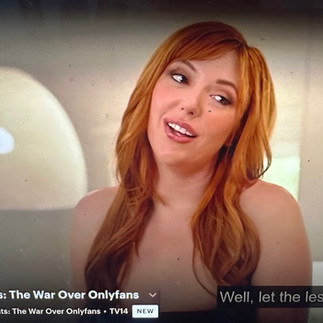
Mainstream TV has a way of turning industry debates into spectacles. Last week, Fox aired “TMZ Presents: The War Over OnlyFans,” now streaming on Hulu. The documentary pitted voices for and against the platform in front of a live audience, who were asked to vote: is OnlyFans toxic, or is it a lifeline?
Among the faces framed in that conversation was Lauren Phillips—multi-award-winning actress, director, gamer, and entrepreneur. Her image is featured prominently in the advertising campaign, plastered across Hulu’s carousel. For creators inside the industry, it’s a familiar face. For the millions of Hulu subscribers who scrolled past, it was a flash of something more: a reminder that the adult creator economy is no longer operating in the shadows.

When Privacy Collides with Publicity
Lauren’s role in the documentary wasn’t scripted to be about her—but she became part of a much larger story when former University of Wisconsin-La Crosse chancellor Joe Gow and his wife Carmen Wilson—known online as Sexy Happy Couple—were outed for their adult content and thrust into a nationwide scandal.
That coverage brought with it not just Gow’s name, but Lauren’s. Photos and videos of her spread across mainstream channels. For someone who’s never hidden her work in adult, it was less about secrecy and more about who else was suddenly in the loop.
“My grandmother found out that I work in adult—she was the one person I really tried to shield from this,” Lauren said.
That’s the paradox of visibility: creators can be transparent with fans, agencies, and colleagues—but when the mainstream machine churns, your story doesn’t just reach your community. It reaches your family, your neighbors, and anyone scrolling the newsstand at the airport.
From Viral to Human
What strikes me about Lauren’s perspective is how ordinary the original moment was.
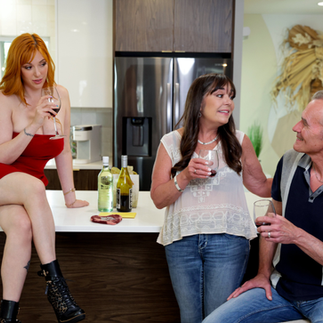
“It seemed like just a regular scene and a cooking segment when I filmed it,” she reflected.
But then it snowballed—fueled by TMZ coverage, national outlets, and the social media echo chamber. What started as just another shoot turned into a story with ripple effects far beyond the set.
This is the double-edged sword of adult creators breaking into mainstream coverage. The attention amplifies reach and legitimizes the work—but it also strips away the protective boundaries that creators build to keep their personal and professional lives distinct.





A Scandal, A Book, A Legacy
Lauren’s story now lives in more places than just Hulu. She’s also featured in the new book A Perfectly Wholesome Scandal by Gow and Wilson. Their social post promoting the book mentioned Lauren directly and reached over 34,000 people on X.
That reach—across platforms, across mediums—is both proof of influence and a reminder that once your name is part of a cultural flashpoint, you don’t control where it goes next.
Why This Matters for Creators
For the broader creator economy, Lauren’s experience is a case study in what happens when adult intersects with mainstream:
The narrative gets reframed. In TMZ’s lens, OnlyFans isn’t just a platform—it’s a cultural battleground.
Creators become symbols. Lauren isn’t just Lauren Phillips anymore; in this documentary, she becomes “proof” in a debate about whether OnlyFans is saving or ruining lives.
Personal walls crumble. Family, friends, and strangers alike get pulled into the conversation, whether you’ve chosen to include them or not.
It raises the question: is the mainstream spotlight worth it? For some, the answer is yes—the exposure can lead to brand deals, collaborations, and new audiences. For others, the cost of losing control over the narrative is too high.
My Take
Watching Lauren Phillips navigate this moment reminded me why stories like hers matter. They reveal the human cost of visibility—the parts of the job that can’t be measured in followers, subs, or earnings.
Mainstream media will always flatten complexity into debate. “Toxic or lifeline?” is easier to package than “a nuanced, evolving ecosystem where real people live and work.” But creators like Lauren are pushing back against that flattening, insisting on telling the full story, even when it’s uncomfortable, even when it means Grandma finds out.
And maybe that’s the real war over OnlyFans—not whether the platform is good or bad, but whether creators get to hold onto their own voices in a world that’s always eager to tell their story for them.
—Ryder Vale | Staff Writer, Only Fans Insider Magazine


![Direct-to-Fan[vue] - Breaking News of a Collaboration with Cardi B and Fanvue](https://static.wixstatic.com/media/08b28b_e88f191daf9c4c06a362d8a991dcbdb2~mv2.png/v1/fill/w_980,h_1211,al_c,q_90,usm_0.66_1.00_0.01,enc_avif,quality_auto/08b28b_e88f191daf9c4c06a362d8a991dcbdb2~mv2.png)


Comments